“Best of the Orchard” Quarter Pecks
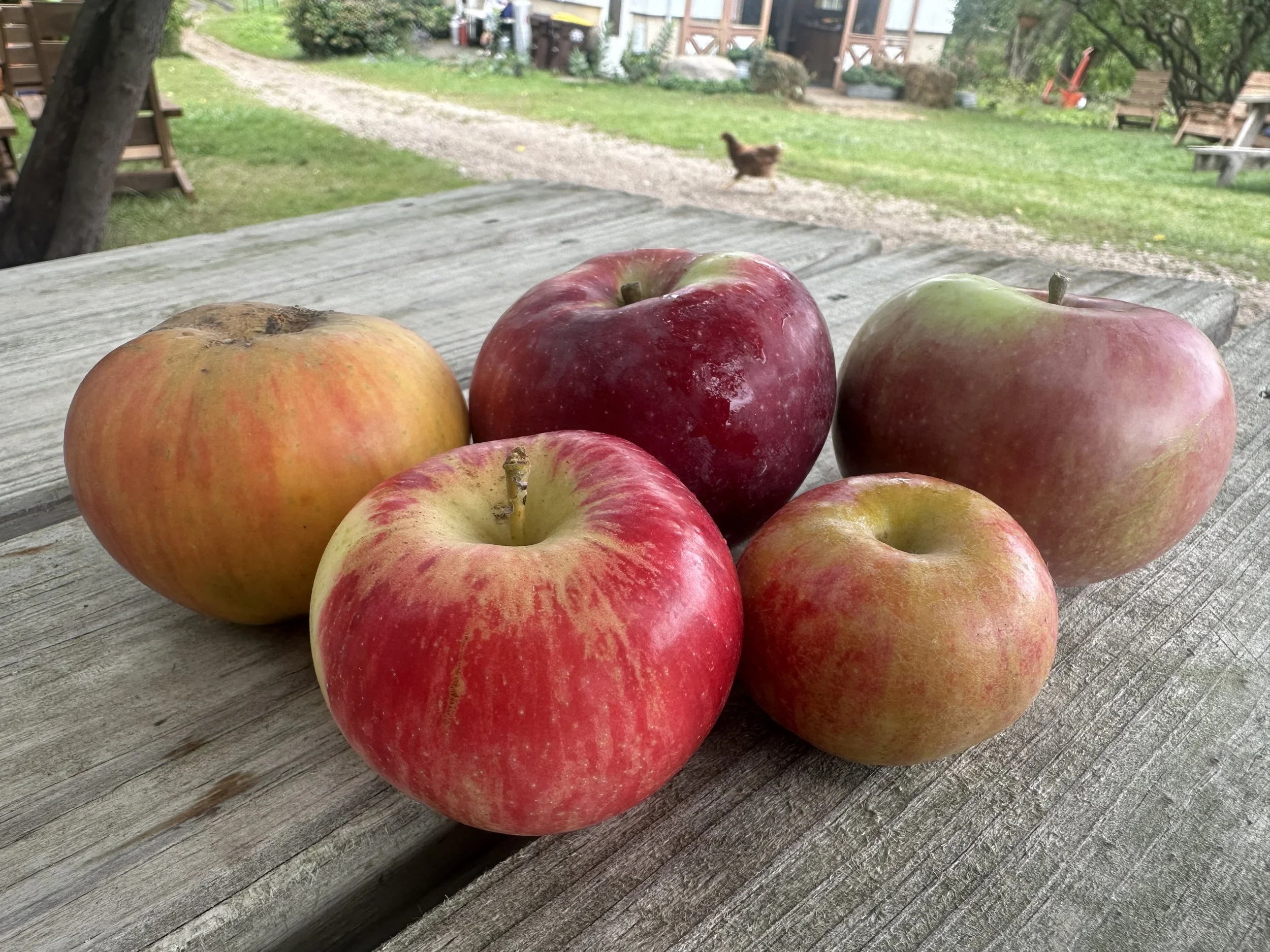
In this week’s “Best of the Orchard” quarter peck bag, we have (from left) Ribston Pippin, Honeycrisp, Paula Red, Chestnut Crab, and McIntosh.
Ribston Pippin
From Yorkshire England, 1709 (via Normandy). Aka the Glory of York, the Ribston Pippin was a dessert apple of renown in Victorian England and arguably England’s greatest apple. Its flavor is intense and its appearance is ruddy and russeted. It is a parent of Cox Orange Pippin, a far better known apple among aficionados. The original tree lived until 1928. Interestingly, Ribston Pippin is a triploid apple, which means it needs to be pollinated by two different varieties.
McIntosh
Discovered by John McIntosh on his farm in Canada, 1811. McIntosh and its progeny (for example, Cortland and Macoun) can be identified by a slightly squat shape, a dark red skin, a slow-to-brown white flesh, and a tart and “vinous” flavor (which means “wine-like.”). McIntosh is an excellent sauce apple since it cooks up saucy and has a fairly complex flavor.
Chestnut Crab
Released by the U of M in 1948, Chestnut Crab is a cross of Malinda and an unknown parent. The Chestnut Crab is unlike any crabapple you’ve ever had before. It is sweet with a dense texture and tastes like a real treat. Chestnut grew out of a seed from a Malinda apple, an apple variety that played a significant role in the U of M’s apple breeding program. Malinda itself is a small, yellow apple that is dry and is worth knowing about, but not necessarily worth eating. It’s pretty amazing how this delicious little gem came from the lackluster Malinda.
Paula Red
Paula Red is a Macintosh seedling discovered in Michigan in 1960 but treated like an honorary Minnesota variety since it’s hardy and widely planted here. It’s characterized by lively acid and is our choice for early-season caramel apples. Cooks up saucy like most members of the Macintosh family. Highly aromatic
“Best of the Orchard” Quarter Pecks
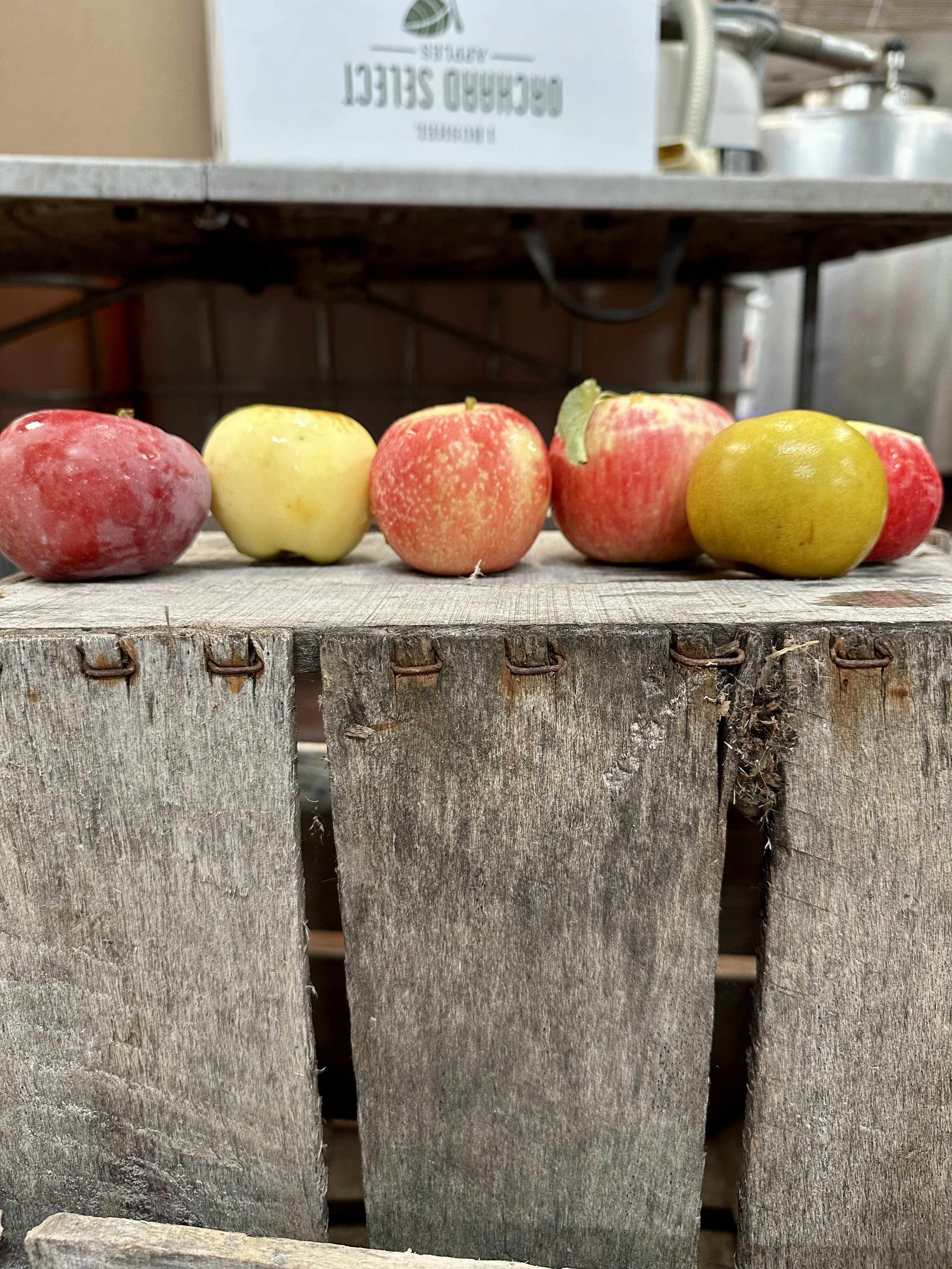
In this week’s “Best of the Orchard” quarter peck bag, we have (from left) Paula Red, Ginger Gold, SweeTango, Zestar!, St. Edmund’s Russet, and Wealthy.
Paula Red
Paula Red is a Macintosh seedling discovered in Michigan in 1960 but treated like an honorary Minnesota variety since it’s hardy and widely planted here. It’s characterized by lively acid and is our choice for early-season caramel apples. Cooks up saucy like most members of the Macintosh family. Highly aromatic
Ginger Gold
Ginger Gold is a delightful apple with a pleasant sweet flavor and a crisp texture. Please don’t say you don’t like yellow apples! Ginger Gold is worth a try and has been a favorite here for years. Ginger Gold was discovered in the remnants of an orchard that Hurricane Camille had wiped out in 1969. It was discovered in Virginia and is a cross of an unknown apple variety with a Golden Delicious.
SweeTango
As much as we love the diversity of flavors and textures in apples, SweeTango may just be the best eating apple. It is a highly flavorful apple with the texture of Honeycrisp. Its patent doesn’t expire until 2028 so if you want to plant a tree of your own (and the tree is known as Minneiska), you’ll have to wait until then. A U of M variety that is a cross of Zestar! and Honeycrisp, released in 2009.
Zestar!
Zestar! is a U of M release from 1999 that is a cross of State Fair x MN1691. It is extremely sweet with a tricky texture: pick it too early and it doesn’t taste as it should or pick it fully-flavored and the texture suffers.
St. Edmund’s Russet
Parentage unknown. Discovered by Richard Harvey in his orchard in Bury St. Edmund’s in Suffolk, England around 1870. In Rowan Jacobson’s book, Apples of Uncommon Character, he describes the flavor of this apple as, “like vanilla pudding infused with pear essence. Early in the season, the richness can be masked by a blast of lemony acid but this gives way to a yellow-cake flavor.” The earliest-ripening russet. As is the case for many early-season apples, St. Edmund’s Russet doesn’t keep well.
Wealthy
Wealthy is the apple that proved Minnesota as an apple growing state. It was planted by Peter Gideon as a seed from a Duchess of Oldenburg apple in Excelsior, Minnesota and harvested (discovered!) in 1868. Peter Gideon’s story is amazing. You can read about it in The Great American Apple Wizard by James R. Curran. Wealthy went on to play a key role in the U of M’s world-class apple breeding program as one of the parents to the Haralson.