Fall 2026 CSA
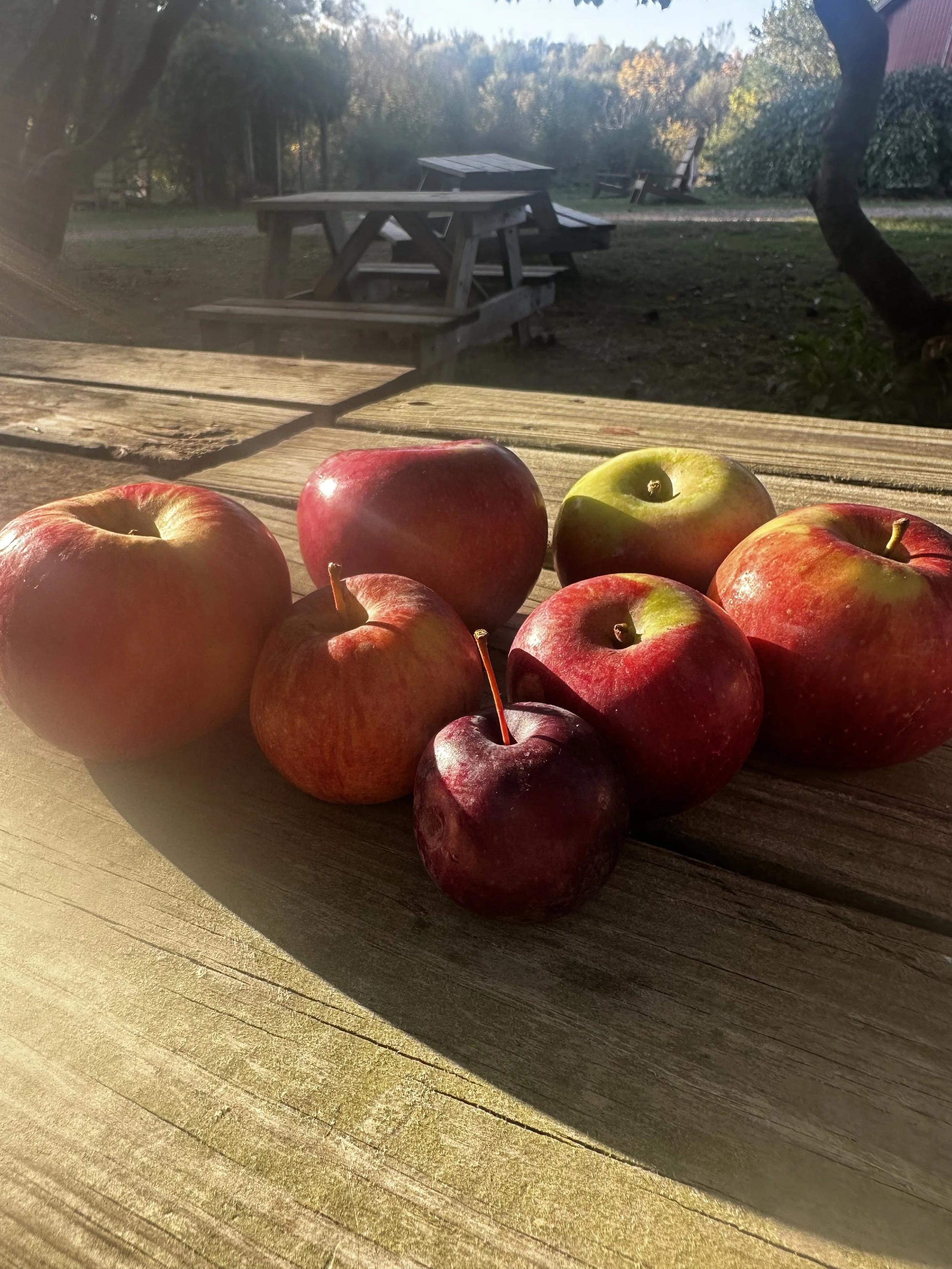
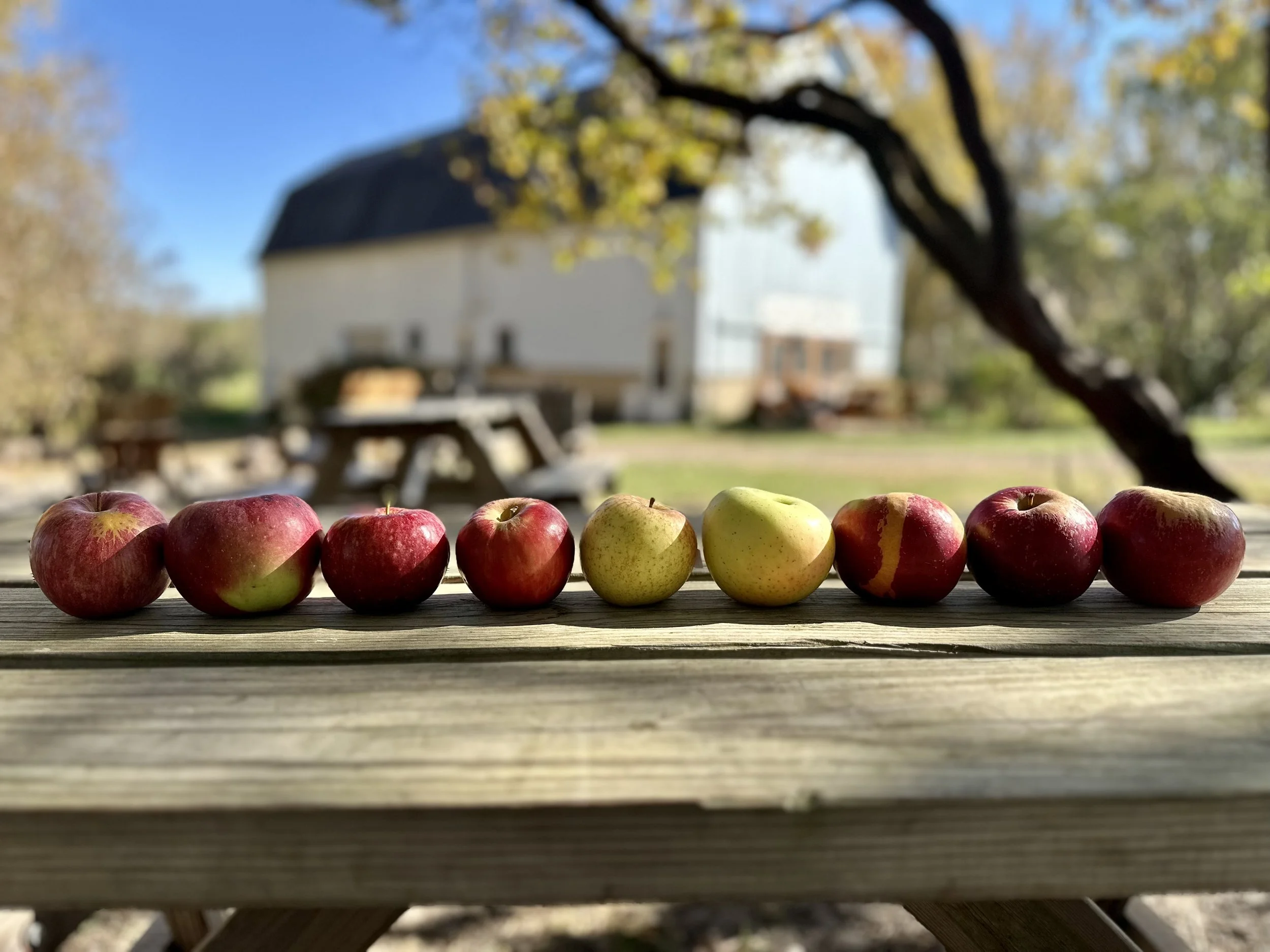
From left: Honeycrisp, Frostbite (front), Cortland, Regent (front), McIntosh, Haralson, Kerr all the way in front
CSA Update, October 11, 2026
I was a bit verbose in today’s video (below), going into all kinds of detail about the apple’s press’s broken hydraulic seal and the newest insect scourge of brown marmorated stink bugs. Never a dull moment!
This week’s jam: honeyberry — like a juicy, tart blueberry
This week’s cider: Perennial — it seemed perfectly suited for the warmer-than- normal weather. Eminently quaffable!
Cortland
Ben Davis x McIntosh
Cornell University, New York, 1915
Cortland is widely grown on the East Coast and also in Quebec and Ontario. Like other McIntosh progeny, Cortland apples are squat with dark red to purplish skin, white flesh, and have a “vinous” flavor (which means that it has some flavor qualities of wine). Cortland is excellent for eating when freshly picked, but its texture suffers in storage. It cooks up saucy.
Honeycrisp
Keepsake x MN1627 (Duchess of Oldenburg x Golden Delicious)
University of Minnesota, 1991
The Honeycrisp apple needs no introduction. It is the crown jewel of the best apple variety breeding program in the world and is surpassed in flavor and texture only by its children, most notably the SweeTango.
Haralson
Wealthy x Malinda
University of Minnesota, 1923
Minnesotans’ favorite apple BHC (before Honeycrisp). A good eater and baker. Use in combination with Cortland for an unbeatable pie or crisp. Stores well, up to four months. The tree itself is extremely cold hardy; however, it is a strong biennial bearer, which means it produces a lot in year one and nothing in year two. Notably for this week, it is a step-sibling of sorts to the Chestnut Crab, both sharing Malinda as a parent.
Regent
Red Duchess x Red Delicious
University of Minnesota, 1963
Here’s what I’ve written in past years: “this is a solid apple. Flavor? It’s a pleasant blend of sugar and acidity. Texture? Crispy enough. And plenty juicy. Really, it’s a solid apple, just nobody’s favorite.” But this year? Oh boy – Regent seemed to love this year’s growing conditions because its flavor is top notch, its acid is exciting, and it may just be my top recommended apple for this week.
McIntosh
Discovered by John McIntosh on his farm
Canada, 1811
McIntosh and its progeny (for example, Cortland and Macoun) can be identified by a slightly squat shape, a dark red skin, a slow-to-brown white flesh, and a tart and “vinous” flavor (which means “wine-like.”) McIntosh is an excellent sauce apple since it cooks up saucy and has a fairly complex flavor.
Kerr
Dolgo x Haralson
South Dakota, 1944
Kerr has a lot going for it: it’s extremely cold hardy, it keeps in cold storage for months, it is scab (fungus) and fireblight (bacteria) resistant, it makes a tasty cider, and it is a delicious apple! Dolgo is an old Russian crabapple with a flavor like a tropical SweeTart; and, of course, you know Haralson, one of the U of M’s second-most notorious releases.
Frostbite
Parentage unknown; aka MN 447
University of Minnesota, 1921
Frostbite is an astounding apple: it is a parent to Keepsake and Sweet Sixteen and a grandparent to Honeycrisp. Its flavor has been described as sugar cane, molasses and malt. To me, its notes of deep warm spices and a nod to savory makes me think of mincemeat pie. It is extremely cold hardy and was used in the breeding program at the U since 1921 and finally released in 2008. Frostbite may be the most unique apple you’ve ever experienced.
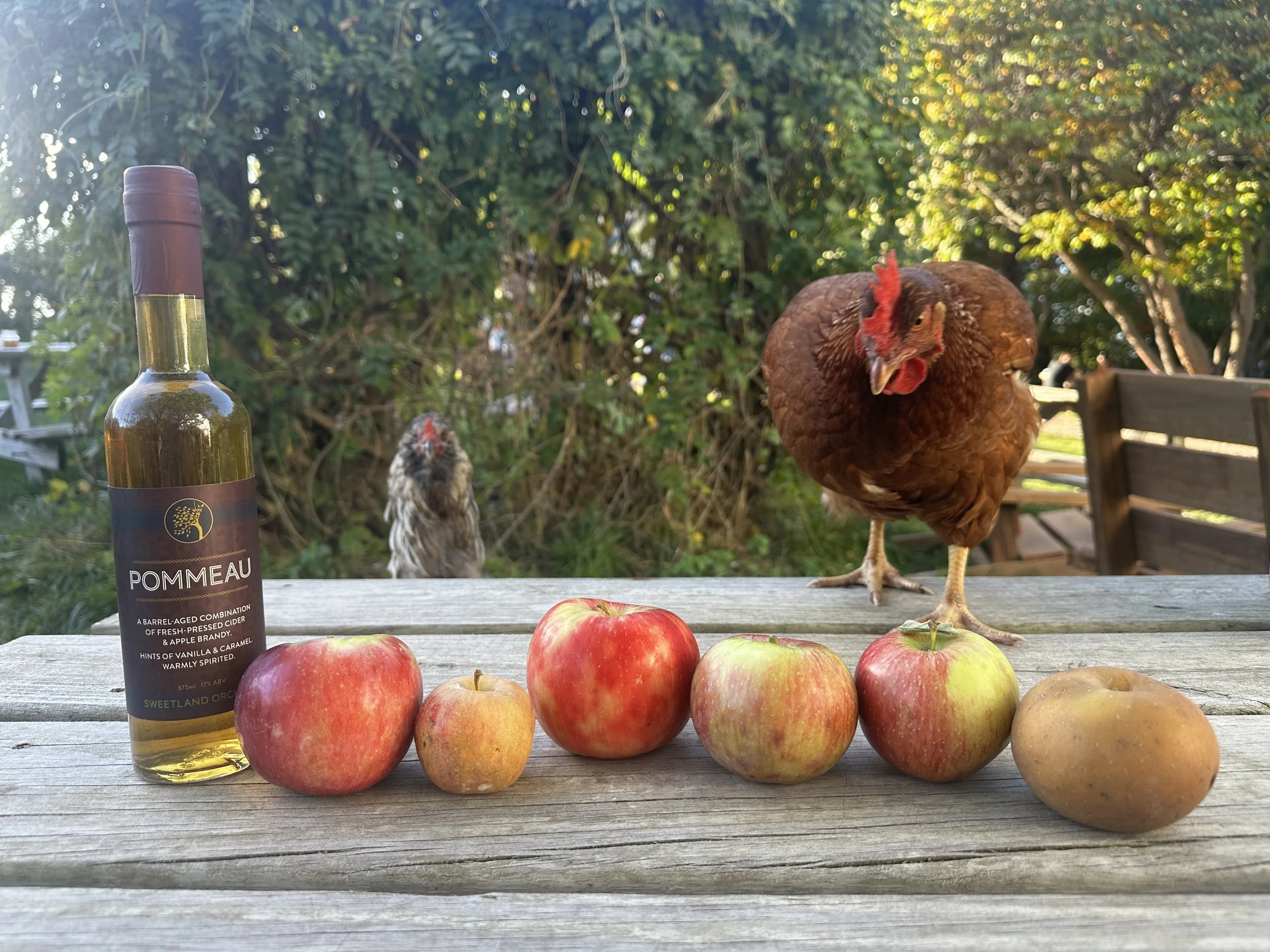
As you can see, I am very popular with the chickens whenever I roll out the CSA apples for a picture and a video. They are well-fed chickens;, but they are also highly opportunistic. From left: Cortland, Chestnut Crab, Honeycrisp, Haralson, Regent, Egremont Russet
CSA Update, October 4, 2026
I think it’s fair to say that we’re in the peak of the season down here and the weather this weekend couldn’t have been better. Finally! We did get rain on Saturday late afternoon/evening, but at this point it isn’t a Saturday unless it rains. I’m looking forward to a dry stretch so we can drive the Gator out into the pig pen with spent pomace from pressing loaded on the back — something I hate to do when the pig pen is a muddy, sloppy mess.
I know I always reference the weather in my missives here, but the weather is such a big deal! Rain means no picking. Heat means pick ASAP. And a significant cold snap forecasted for post leaf-peak in the Twin Cities (https://www.mprnews.org/story/2026/10/02/fall-colors-turning-in-minnesota-north-of-interstate-94) has me thinking I’d better have a plan to pick all of the remaining apples from the trees in case it’s a season ending kind of cold snap. Of course, ideal fall weather also signifies orchard season, so we saw some crowds down here really for the first time this year. After a few lazy, slow-paced Saturdays, the teens needed to find a new gear!
We got a lot of picking done this week and for some of our more limited varieties, it seems like they come in the door at the beginning of the week and are out the door by the end of the week. That means Ashmead’s Kernel and Ribston Pippin have come and gone — the last of these went out in boxes on Sunday and I didn’t even have any for a photo! Thankfully we have one of our “weird” varieties — Frostbite — coming out of the orchard in abundance this week and should be sticking around for a while.
The Regent and Haralson and Honeycrisp harvests were stellar this year though the Haralson suffered from stinkbug damage, the likes of which I have never seen before. Whether that damage is from a common stink bug or the invasive brown marmorated stink bug (BMSB) is yet to be seen; I participate in a Minnesota Department of Agriculture (MDA) invasive pest scouting program and they will let me know soon if the dreaded BMSB has finally made it into our neck of the woods. Based on the Haralson damage, I would say yes.
Cortland and McIntosh are still sticking around, but the Chestnut supply is down to less than a bushel, so we’ll be saying goodbye to that variety for the season soon.
Egremont Russet
Somerset, England, 1872
Like many russets, the Egremont has high sugar and high acid, resulting in an intense flavor. It has some tannins too, mostly in the skin, which gives it that attribute of drying out your mouth. Although its texture is best described as dense-crunchy – not how we Americans like our apple texture – it is regarded as the best of the russets. Its disease resistance and self-fertility make it a popular apple for home growers in England. Commercially, it is the third most cultivated apple in England.
Ribston Pippin
Yorkshire England, 1709 (via Normandy)
Aka the Glory of York, the Ribston Pippin was a dessert apple of renown in Victorian England and arguably England’s greatest apple. Its flavor is intense and its appearance is ruddy and russeted. It is a parent of Cox Orange Pippin, a far better known apple among aficionados. The original tree lived until 1928. Interestingly, Ribston Pippin is a triploid apple, which means it needs to be pollinated by two different varieties. I really love this one.
Cortland
Ben Davis x McIntosh
Cornell University, New York, 1915
Cortland is widely grown on the East Coast and also in Quebec and Ontario. Like other McIntosh progeny, Cortland apples are squat with dark red to purplish skin, white flesh, and have a “vinous” flavor (which means that it has some flavor qualities of wine). Cortland is excellent for eating when freshly picked, but its texture suffers in storage. It cooks up saucy.
Chestnut Crab
Malinda x unknown
U of M, 1948
The Chestnut Crab is unlike any crabapple you’ve ever had before. It is sweet with a dense texture and tastes like a real treat. Chestnut grew out of a seed from a Malinda apple, an apple variety that played a significant role in the U of M’s apple breeding program.
Honeycrisp
Keepsake x MN1627 (Duchess of Oldenburg x Golden Delicious)
University of Minnesota, 1991
The Honeycrisp apple needs no introduction. It is the crown jewel of the best apple variety breeding program in the world and is surpassed in flavor and texture only by its children, most notably the SweeTango.
Haralson
Wealthy x Malinda
University of Minnesota, 1923
Minnesotans’ favorite apple BHC (before Honeycrisp). A good eater and baker. Use in combination with Cortland for an unbeatable pie or crisp. Stores well, up to four months. The tree itself is extremely cold hardy; however, it is a strong biennial bearer, which means it produces a lot in year one and nothing in year two. Notably for this week, it is a step-sibling of sorts to the Chestnut Crab, both sharing Malinda as a parent.
Regent
Red Duchess x Red Delicious
University of Minnesota, 1963
Here’s what I’ve written in past years: “this is a solid apple. Flavor? It’s a pleasant blend of sugar and acidity. Texture? Crispy enough. And plenty juicy. Really, it’s a solid apple, just nobody’s favorite.” But this year? Oh boy – Regent seemed to love this year’s growing conditions because its flavor is top notch, its acid is exciting, and it may just be my top recommended apple for this week.
Ashmead’s Kernel
Grown from a seed planted by William Ashmead
England, early 1700’s
First, we must agree that we won’t judge an apple by its appearance. Ashmead’s is fully russeted and looks more like a potato than an apple. But if you’re willing to judge on flavor alone, you’ll find Ashmead’s to be superlative: its high acid and high sugar levels make Ashmead’s one of the most intensely and richly flavored apples. Best for fresh eating and also for cider.
CSA Update, September 27, 2026
Here I am, writing with another wet dispatch from Soggyland Orchard! If last night’s rain doesn’t get us officially out of drought, Tuesday’s rain is sure to do so. The rain is a wonderful recharge for the soil and will help ensure that the trees will come out of the winter stronger than they would’ve otherwise, so overall I’m grateful for the wet.
We keep picking. This week it was Ashmead’s Kernel, Egremont Russet, Bramtot, Foxwhelp, Haralson, Hubbardston Nonesuch, Macoun, Regent, and Sweet 16. This week’s pressing includes a lot of Haralson, Estival, and a healthy mix of any early season apples we decided whose time had passed.
We also wrapped up all of our packaging for our apple brandy products, which is a big, big deal! I suppose the timeframe for making apple brandy isn’t that far from the timeline for making ice cider, but the apple brandy has been sitting in a barrel for 2-½ years, so it feels wonderful to be getting it and its associated products (eau de vie, which is unaged brandy and an apple brandy Old Fashioned cocktail) out the door. At last!
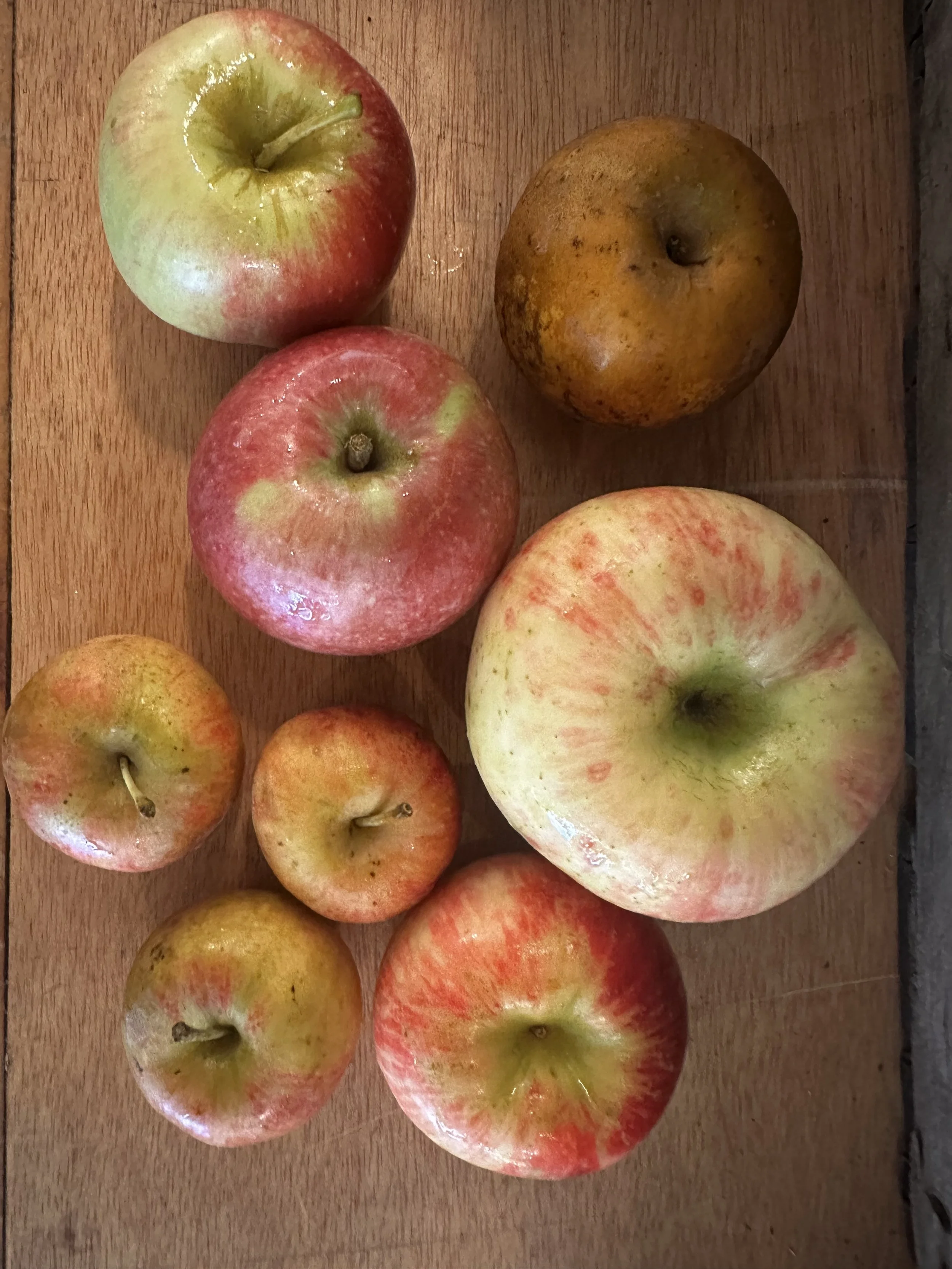
From right and proceeding clockwise: Estival, Honeycrisp, Chestnut Crab, Paula Red, Sweet Sixteen, and Ashmead’s Kernel.
On to the apples in your box:
Honeycrisp
Keepsake x MN1627 (Duchess of Oldenburg x Golden Delicious) released by the University of Minnesota in 1991. It is the crown jewel of the best apple variety breeding program in the world and is surpassed in flavor and texture only by its children, most notably the SweeTango.
Chestnut Crab
Malinda x unknown, U of M, 1948
The Chestnut Crab is unlike any crabapple you’ve ever had before. It is sweet with a dense texture and tastes like a real treat. Chestnut grew out of a seed from a Malinda apple, an apple variety that played a significant role in the U of M’s apple breeding program.
Sweet Sixteen
Northern Spy x Frostbite (MN447)
U of M, 1977
Sweet Sixteen is the second variety the U released that was a cross between Northern Spy and Frostbite; the other is Keepsake. Like its sibling, Sweet Sixteen has yellow-ish flesh and bounds of flavor. The best versions of this variety have a cherry popsicle flavor and sometimes an undercurrent of anise. They’re tricky to pick: underripe and they’re hard and sweet without much flavor; overripe and they’re on the ground.
Ashmead’s Kernel
Grown from a seed planted by William Ashmead
England, early 1700’s
First, we must agree that we won’t judge an apple by its appearance. Ashmead’s is fully russeted and looks more like a potato than an apple. But if you’re willing to judge on flavor alone, you’ll find Ashmead’s to be superlative: its high acid and high sugar levels make Ashmead’s one of the most intensely and richly flavored apples. Best for fresh eating and also for cider.
Delbarde Estivale
Golden Delicious x Stark Jonagrimes
aka Delcorf, Dalili, Monidel
France, 1956
Estival, as it’s known in Minnesota, is not a commonly grown apple here, which is a shame. It has a creamy texture, hints of anise, and is absolutely bursting with juice and a pleasing amount of acid. They’re not the most attractive apple ,nor are they the crispiest, and they also bruise easily, but Estival is still a solid apple worth an eat and, for my salt, easy to grow.
CSA Update, September 20, 2026
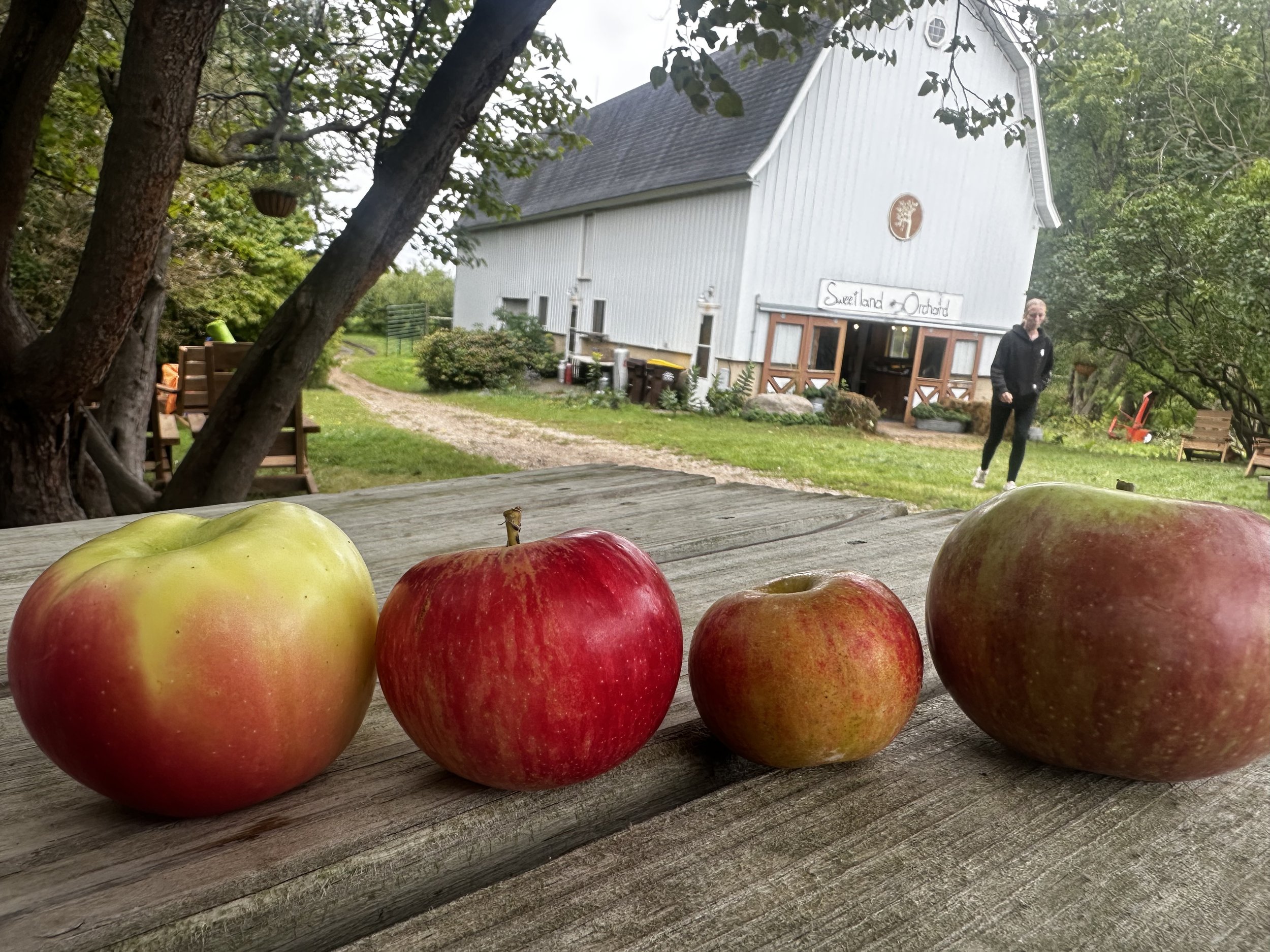
That’s an apple packer/CSA delivery person in the background.
We got some much needed rain that sogged everything up for Saturday but by today, it had all soaked in like it had never rained — save for the bonfire firewood, of course. So we did the bottling projects while it was wet and now that it’s cleared up, all of the Haralson are coming in from the orchard. Yes, that’s awfully early for Haralson. Growing up, I always thought of Haralson as an October 1 apple and in recent history, we’ve begun picking it during the last week of September. Because of the rain, we’re actually a bit late picking it this year because everything — apples, corn, beans — is two weeks early.
In boxes this week you have Minnesota Mule (half share subscribers) or Cherry Rhubarb (full share subscribers). You also have the following apples:
Honeycrisp
Keepsake x MN1627 (Duchess of Oldenburg x Golden Delicious) released by the University of Minnesota in 1991. It is the crown jewel of the best apple variety breeding program in the world and is surpassed in flavor and texture only by its children, most notably the SweeTango.
Chestnut Crab
Malinda x unknown, U of M, 1948
The Chestnut Crab is unlike any crabapple you’ve ever had before. It is sweet with a dense texture and tastes like a real treat. Chestnut grew out of a seed from a Malinda apple, an apple variety that played a significant role in the U of M’s apple breeding program.
McIntosh
Canada, 1811
Yes, it’s McIntosh this week and not Paula Red, like I said in the video. By the time Sunday afternoon came around I couldn’t remember what apples went into boxes this week so I asked my daughter, who packed them up. And she misled me! McIntosh is, at least, the more classic choice for an apple and if you’re a sauce maker, a lovely sauce apple.
Maidens Blush
New Jersey, late 1700’s
aka Lady Blush, Red Cheek.
Maiden Blush was a surprise addition to the orchard because the nursery had mislabeled its stock, but we’re happy to have it here. Good for eating and a gem for drying, the flesh is fine-grained and tender. Picked slightly early, the apple has good acid. Picked fully ripe, you’ll experience less acid for a more mellow flavor. Cooks quickly into sauce. Widely grown in the southern U.S.
CSA Update, September 13, 2026
I’ve got the teens in charge of the CSA this year — including one of my own — so I helped them pack it up for the first time, gave them all of the city parking tips I could think of, and sent them off in the van with faith in the power of back-up cameras.
Yesterday was our first day open of the season and because of the seasonally-appropriate weather, we got to see lots of familiar faces. After spending the entire year in the orchard alone or with just one or two other people as we’re pruning or planting, it feels totally different to have people out there. It’s nice — I like the energy shift and call me odd, but I think the trees like having an appreciative audience too. Apple trees need to be managed to produce fruit annually and so the more energy you put into them, the more they perform; that’s why I think they appreciate the attention from all of the orchard visitors and I just imagine them preening as people admire their crop.
For this week’s apples, we have Paula Red, Honeycrisp, SweeTango, McIntosh, and St. Edmund’s Russet.
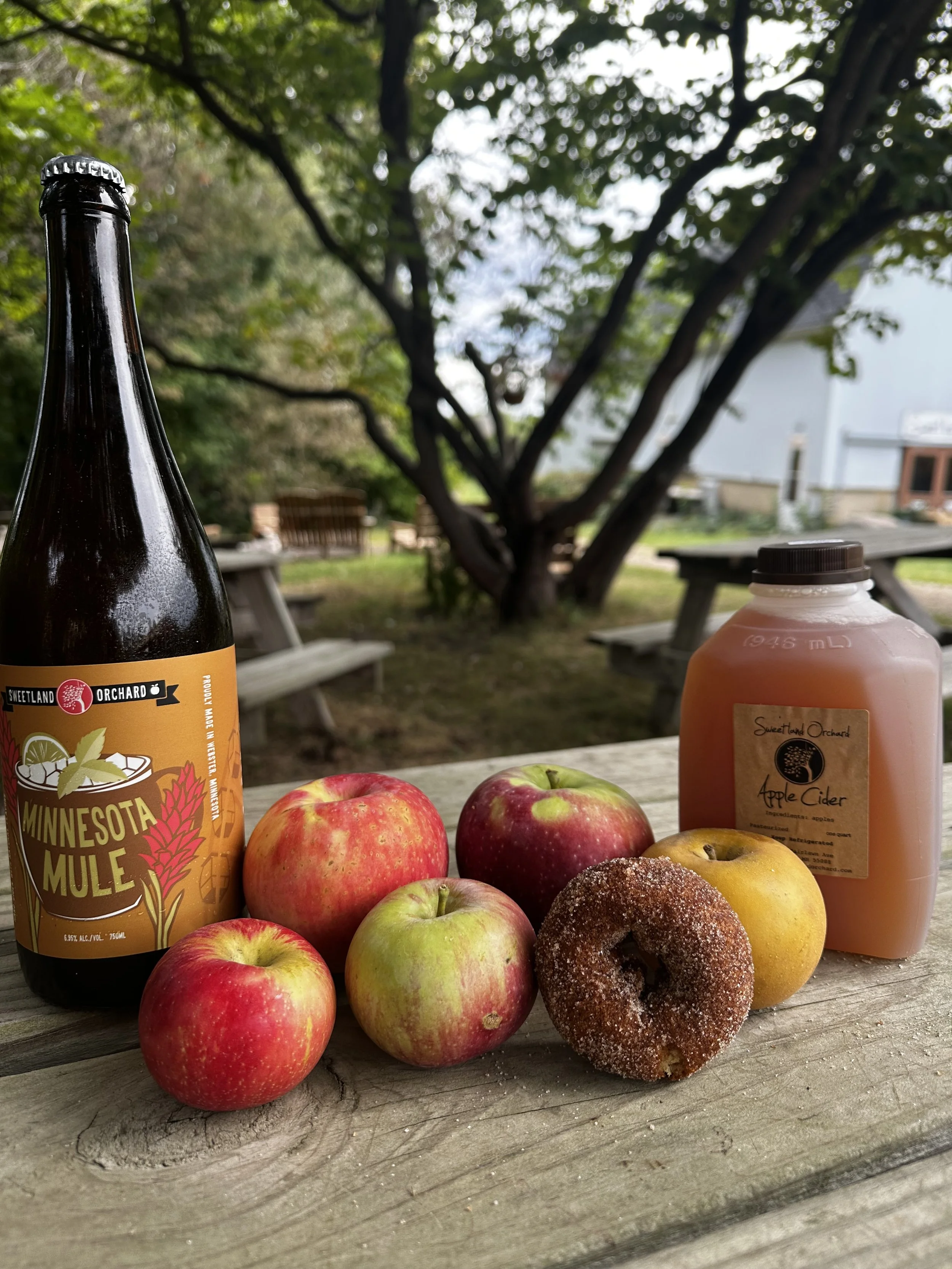
Paula Red is a Macintosh seedling discovered in Michigan in 1960, but treated like an honorary Minnesota variety since it’s hardy and widely planted here. It has lively acid and since I was a kid, has been my choice for early-season apples. Cooks up saucy like most members of the Macintosh family.
Honeycrisp was a crop of Keepsake x MN1627 (Duchess of Oldenburg x Golden Delicious) released by the University of Minnesota in 1991. It is the crown jewel of the best apple variety breeding program in the world and is surpassed in flavor and texture only by its children, most notably the SweeTango.
Speaking of SweeTango: it is a cross of Honeycrisp and Zestar! released by the University of Minnesota in 2009. As much as we love the diversity of flavors and textures in apples, SweeTango may just be the best eating apple. It is a highly flavorful apple with the texture of Honeycrisp. It makes decent hard cider too. Its patent doesn’t expire until 2028 so if you want to plant a tree of your own (and the tree is known as Minneiska), you’ll have to wait until then.
McIntosh is one of two heirloom apples in the box this week. It was discovered by John McIntosh on his farm in Canada in 1811. McIntosh and its progeny (for example, Cortland and Macoun) can be identified by a slightly squat shape, a dark red skin, a slow-to-brown white flesh, and a tart and “vinous” flavor (which means “wine-like.”) McIntosh is an excellent sauce apple since it cooks up saucy and has a fairly complex flavor.
Lastly, St. Edmunds Russet was discovered by Richard Harvey in his orchard in Bury St. Edmund’s in Suffolk, England around 1870 with no idea what its parents are. In Rowan Jacobson’s book, Apples of Uncommon Character, he describes the flavor of this apple as, “like vanilla pudding infused with pear essence. Early in the season, the richness can be masked by a blast of lemony acid but this gives way to a yellow-cake flavor.” The earliest-ripening russet. Doesn’t keep well.
Offering Community Supported Agriculture (CSA) box lets us deliver a best-of-the-orchard package of apples, cider, and cider donuts to you on a weekly or biweekly schedule during the fall. Every Sunday morning we load up the van and bring your pre-ordered box to one of the drop-off sites listed below.
You can choose a full share, which is weekly delivery for ten weeks from September 13 through November 15; or you can choose a half-share, which is every-other-weekly delivery during that same time period. If you choose a half-share, we’ll let you know if your delivery dates will be September 13, September 27, October 11, October 25, and November 8; or if they’ll be September 20, October, 4, October 18, November 1, and November 15.
You’ll be able to designate your pick-up location at check-out, and this fall’s pick-up spots include:
Dogwood Coffee Grand
Dogwood Coffee East Lake
Dogwood Coffee St. Paul (University)
Dogwood Coffee NE
Well Nourished Farmstand, New Brighton
France 44
Sweetland Orchard
You can add on to your basic CSA package too (all the way at the bottom of this page) with items like apple chips, apple crisp, or more of anything that’s already in your box.
If you’d like to help me save on charges related to credit card processing, I’d be very happy if you used Venmo (sweetland-orchard) or wanted to send a check. If you use Venmo, let me know what your order is and your preferred pick-up site and I’ll get back to you with a confirmation. Questions? Get in touch via email at sweetlandorchard@gmail.com or text to 651-252-4337.
Essence of the Orchard
This CSA package offers a basic (and delicious) version of what we do around here: apples, fresh-pressed cider, fermented cider, and cider donuts.
Half peck of apples, mixed varieties
1/2 gallon fresh-pressed cider
Half-dozen cider donuts
A four-pack of cider or one 750-ml bottle
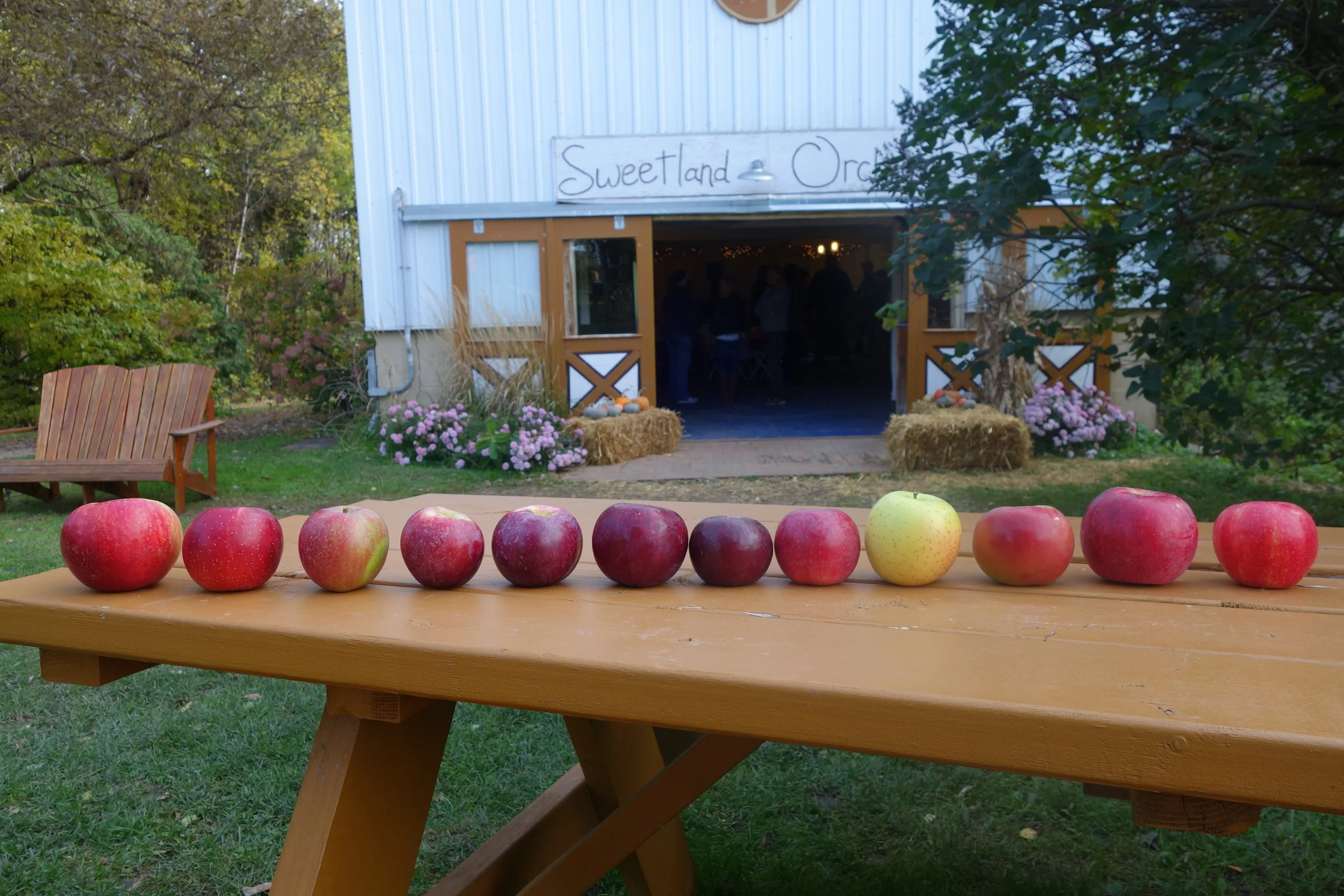
This CSA package offers a basic (and delicious) version of what we do around here: apples, fresh-pressed cider, fermented cider, and cider donuts.
Half peck of apples, mixed varieties
1/2 gallon fresh-pressed cider
Half-dozen cider donuts
A four-pack of cider or one 750-ml bottle
You can choose a full share, which is weekly delivery for ten weeks from September 13 through November 15; or you can choose a half-share, which is every-other-weekly delivery during that same time period. If you choose a half-share, we’ll let you know if your delivery dates will be September 13, September 27, October 11, October 25, and November 8; or if they’ll be September 20, October, 4, October 18, November 1, and November 15.
Pick up locations include:
Dogwood Coffee Grand
Dogwood Coffee East Lake
Dogwood Coffee St. Paul (University)
Dogwood Coffee NE
Well Nourished Farmstand, New Brighton
France 44
Sweetland Orchard
You can add on to your basic CSA package too with items like apple chips, apple crisp, or more of anything that’s already in your box.
If you’d like to help me save on charges related to credit card processing, I’d be very happy if you used Venmo (sweetland-orchard) or wanted to send a check. If you use Venmo, let me know what your order is and your preferred pick-up site and I’ll get back to you with a confirmation.
Apple Lovers
This package is for apple lovers with an entire mixed peck of apples included in it. It also bumps up the quantities of apples, fresh-pressed cider, and cider donuts and excludes hard cider.
Peck of apples, mixed varieties
Gallon of fresh-pressed cider
Dozen cider donuts
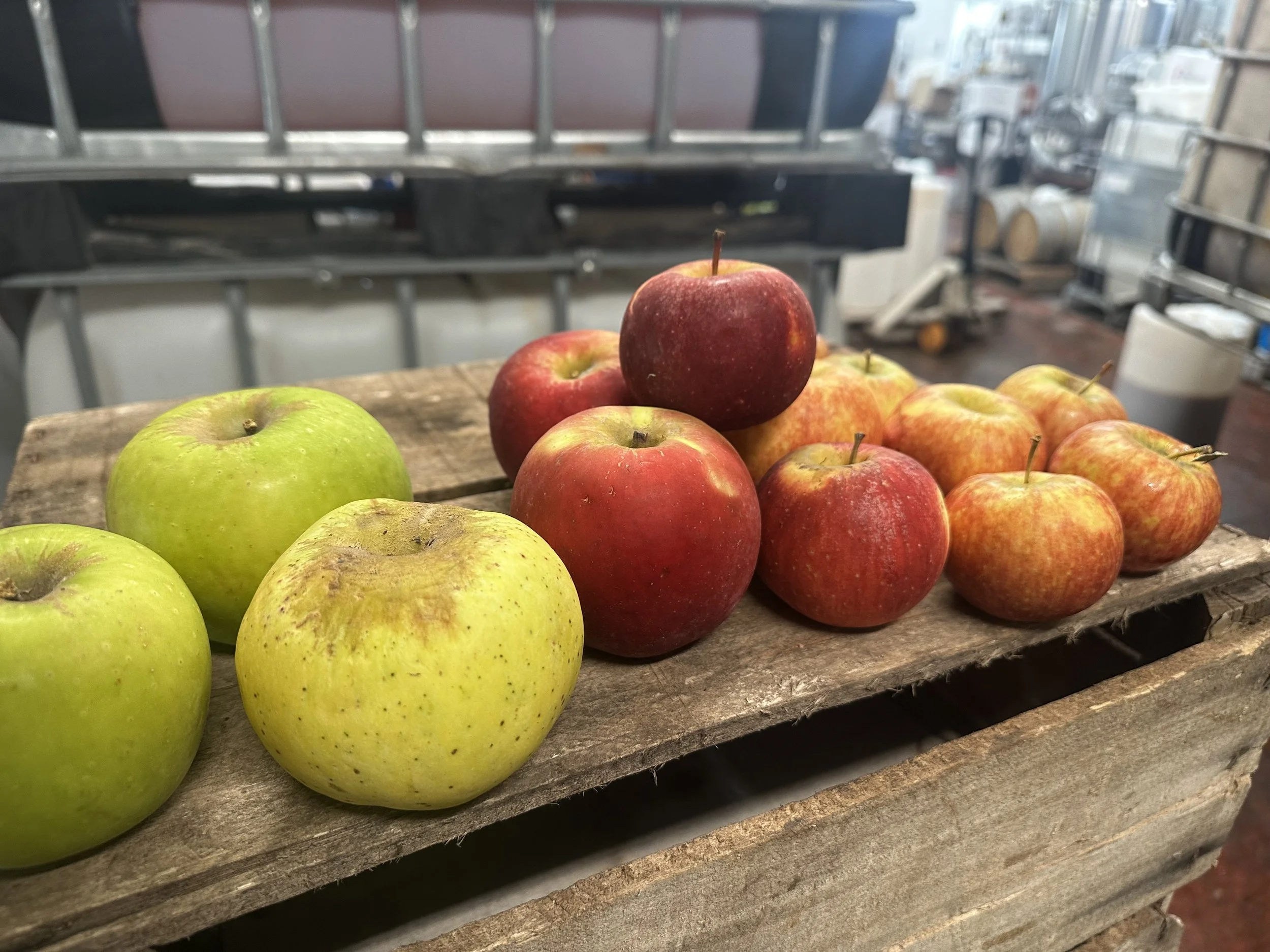
This package is for apple lovers with an entire mixed peck of apples included in it. It also bumps up the quantities of apples, fresh-pressed cider, and cider donuts and excludes hard cider.
Peck of apples, mixed varieties
Gallon of fresh-pressed cider
Dozen cider donuts
You can choose a full share, which is weekly delivery for ten weeks from September 13 through November 15; or you can choose a half-share, which is every-other-weekly delivery during that same time period. If you choose a half-share, we’ll let you know if your delivery dates will be September 13, September 27, October 11, October 25, and November 8; or if they’ll be September 20, October, 4, October 18, November 1, and November 15.
Pick up locations include:
Ale Jail St. Paul
Dogwood Coffee St. Paul
Dogwood Coffee East Lake
Dogwood Coffee NE
Well Nourished Farmstand, New Brighton
Ale Jail Crystal
France 44
Sweetland Orchard
You can add on to your basic CSA package too with items like apple chips, apple crisp, or more of anything that’s already in your box.
If you’d like to help me save on charges related to credit card processing, I’d be very happy if you used Venmo (sweetland-orchard) or wanted to send a check. If you use Venmo, let me know what your order is and your preferred pick-up site and I’ll get back to you with a confirmation.
Apple Lovers + Hard Cider
The Apple Lovers + Hard Cider CSA package includes more apples, more fresh-pressed cider, more donuts, and hard cider too! The apples will be a mix of whichever varieties are best that week and the hard cider will be “dealer’s choice” depending on what we’ve just bottled, what the weather’s like, and what we think would be great to drink in any given week.
Peck of apples, mixed varieties
Gallon of fresh-pressed cider
Dozen cider donuts
A four-pack of cider or one 750-ml bottle
Hello, kindred spirits!
The Apple Lovers + Hard Cider CSA package includes more apples, more fresh-pressed cider, more donuts, and hard cider too! The apples will be a mix of whichever varieties are best that week and the hard cider will be “dealer’s choice” depending on what we’ve just bottled, what the weather’s like, and what we think would be great to drink in any given week.
Peck of apples, mixed varieties
Gallon of fresh-pressed cider
Dozen cider donuts
A four-pack of cider or one 750-ml bottle
You can choose a full share, which is weekly delivery for ten weeks from September 13 through November 15; or you can choose a half-share, which is every-other-weekly delivery during that same time period. If you choose a half-share, we’ll let you know if your delivery dates will be September 13, September 27, October 11, October 25, and November 8; or if they’ll be September 20, October, 4, October 18, November 1, and November 15.
Pick up locations include:
Ale Jail St. Paul
Dogwood Coffee St. Paul
Dogwood Coffee East Lake
Dogwood Coffee NE
Well Nourished Farmstand, New Brighton
Ale Jail Crystal
France 44
Sweetland Orchard
You can add on to your basic CSA package too with items like apple chips, apple crisp, or more of anything that’s already in your box.
If you’d like to help me save on charges related to credit card processing, I’d be very happy if you used Venmo (sweetland-orchard) or wanted to send a check. If you use Venmo, let me know what your order is and your preferred pick-up site and I’ll get back to you with a confirmation.
We understand that you too love apples, but that you’re doing your best to limit your donut consumption, so our Petite Package includes the following:
Quarter peck of apples, mixed varieties
One cider donut
Quart of fresh-pressed cider
You can choose a full share, which is weekly delivery for ten weeks from September 13 through November 15; or you can choose a half-share, which is every-other-weekly delivery during that same time period. If you choose a half-share, we’ll let you know if your delivery dates will be September 13, September 27, October 11, October 25, and November 8; or if they’ll be September 20, October, 4, October 18, November 1, and November 15.
Pick up locations include:
Ale Jail St. Paul
Dogwood Coffee St. Paul
Dogwood Coffee East Lake
Dogwood Coffee NE
Well Nourished Farmstand, New Brighton
Ale Jail Crystal
France 44
Sweetland Orchard
You can add on to your basic CSA package too with items like apple chips, apple crisp, or more of anything that’s already in your box.
If you’d like to help me save on charges related to credit card processing, I’d be very happy if you used Venmo (sweetland-orchard) or wanted to send a check. If you use Venmo, let me know what your order is and your preferred pick-up site and I’ll get back to you with a confirmation.
Petite Package
We understand that you too love apples, but that you’re doing your best to limit your donut consumption, so our Petite Package includes the following:
Quarter peck of apples, mixed varieties
One cider donut
Quart of fresh-pressed cider
CSA Add-Ons
If you choose an add-on, it will be delivered along with your full-share or half-share CSA.
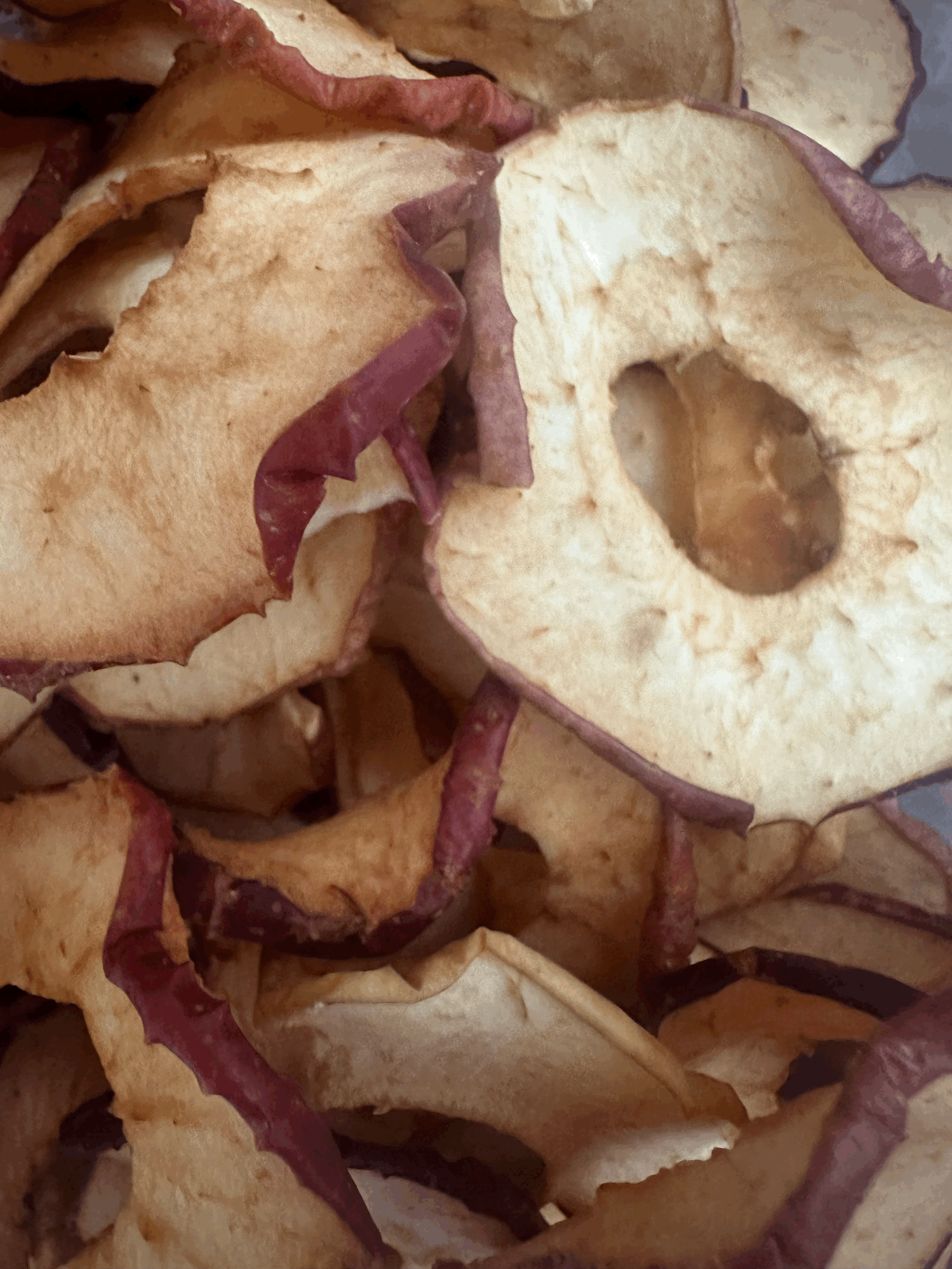
We core and slice apples — leaving the peel on — and then dehydrate them. A great snack with sweetness and tang delivered in a BIG bag. You’ll get five bags total with your half-share CSA or ten bags total with your full-share CSA.
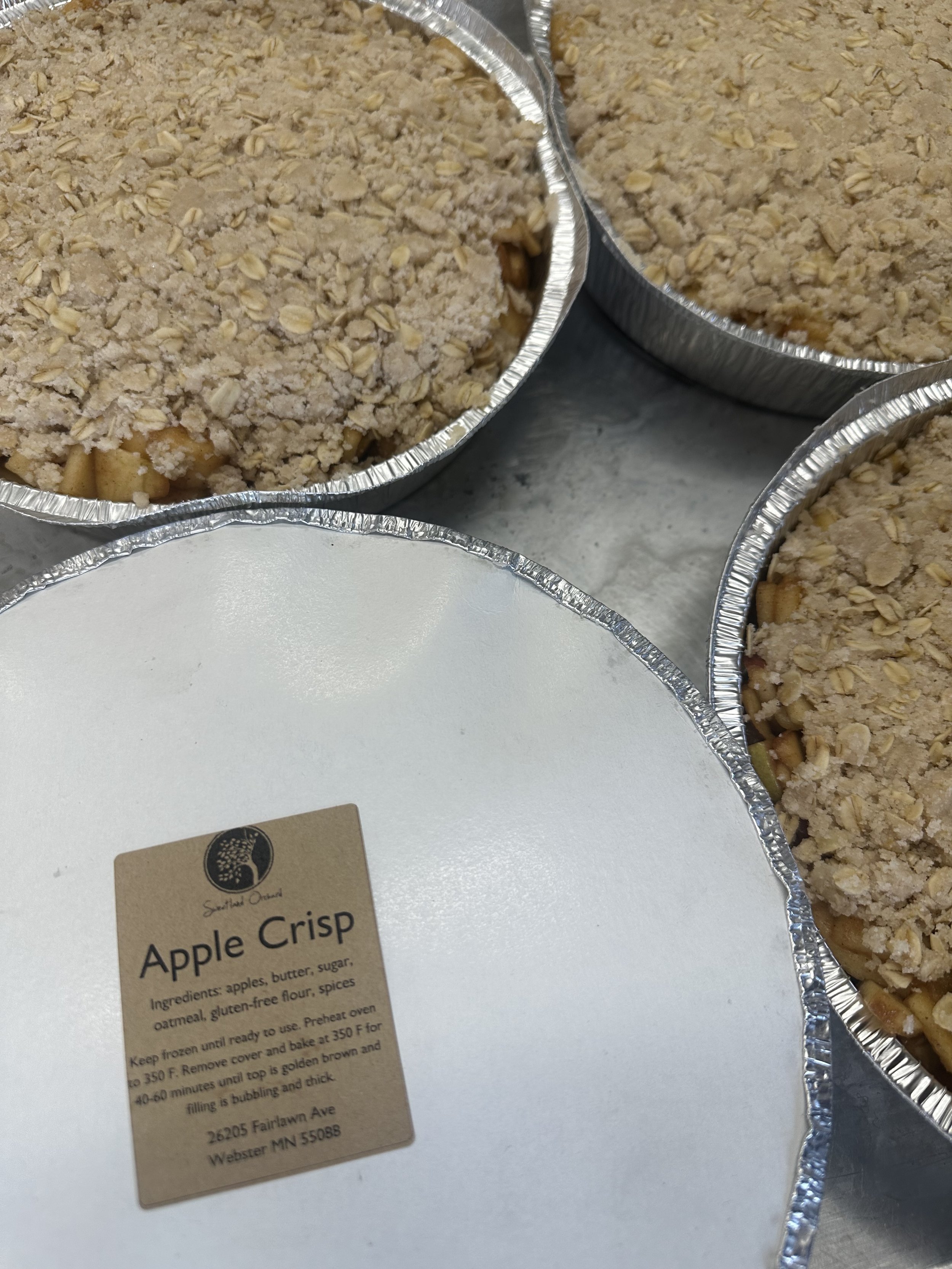
We use our best apples for baking and blend them with sugar, cinnamon, Noëlle ice cider and a touch of salt. We let them macerate to release their juices and compact and then cram as many as we can into a pan and top it with butter, oats, sugar, and King Arthur gluten-free flour. You won’t even know it’s gluten free.
Choose a half share for delivery with your CSA every other week; or a full share for delivery with your CSA every week.
Crisps are frozen when they depart the orchard, so you’ll have to bake it at home and endure the aroma of butter, spices, oats, and apples. Darn it.
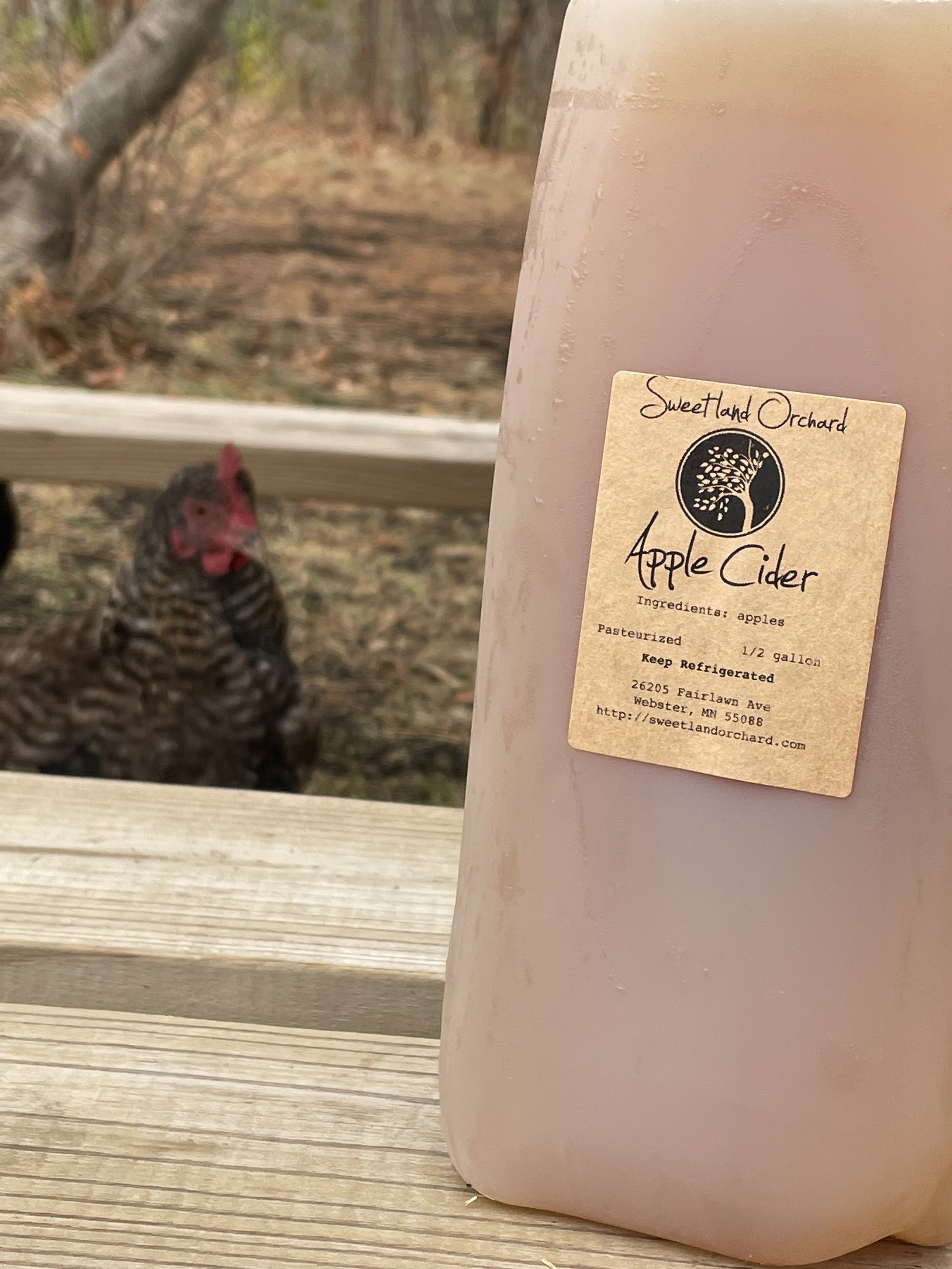
Half-gallon of fresh-pressed cider, pressed weekly here at the orchard. Our fresh cider is gently pasteurized to 160 degrees to retain as much fresh flavor as possible.
A half-share will entail delivery of a half-gallon every other week; a full share gets you a delivery of a half-gallons every week for ten weeks along with your base CSA package.

A bottle or four-pack of our hard cider will be included with your CSA delivery. We select which cider to include with each delivery depending on what we think will be best to drink that week. You may get a four-pack, a 750, ice cider . . . it’s the cidermaker’s pick! Thanks for putting yourselves in our hands. If you choose a half share, you’ll get hard cider delivered every other week. A full share will entail a delivery of hard cider every week.
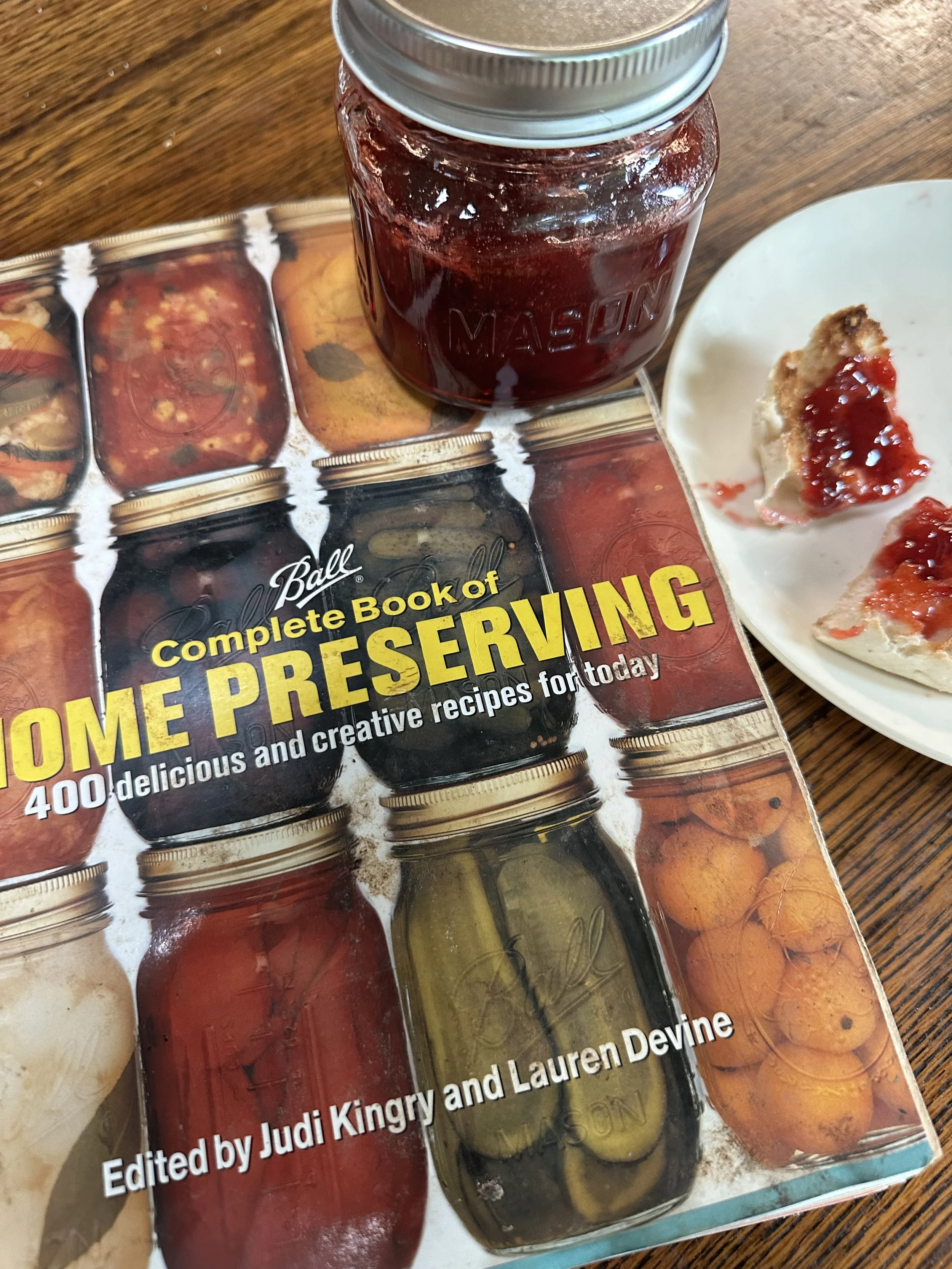
If you add on jam, jelly, or apple butter to your CSA share, you’ll get a delivery along with your CSA. We typically make raspberry, strawberry, apricot, and honeyberry jam, crabapple jelly, and apple butter. Expect something different with each delivery: five jars delivered with your half-share CSA or ten jars delivered with your full share CSA.